SpotHop: Parking Availability App
An entrepreneurship and product design project focused on validating a real-world problem, designing a mobile app concept, and testing market demand through customer research and MVP experimentation.
Overview
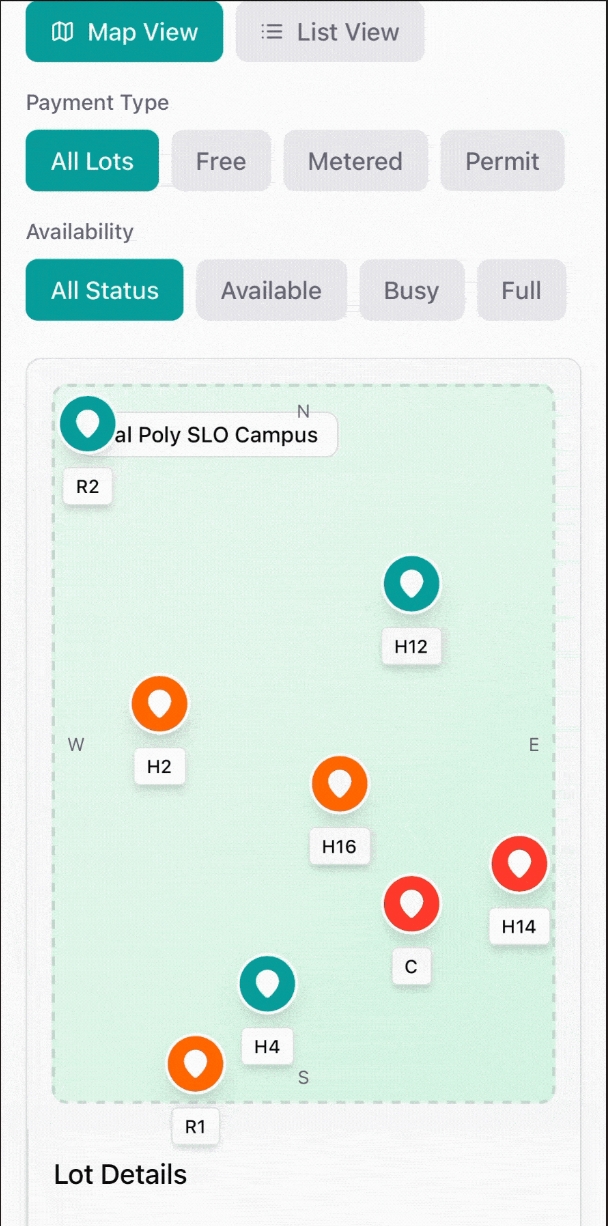
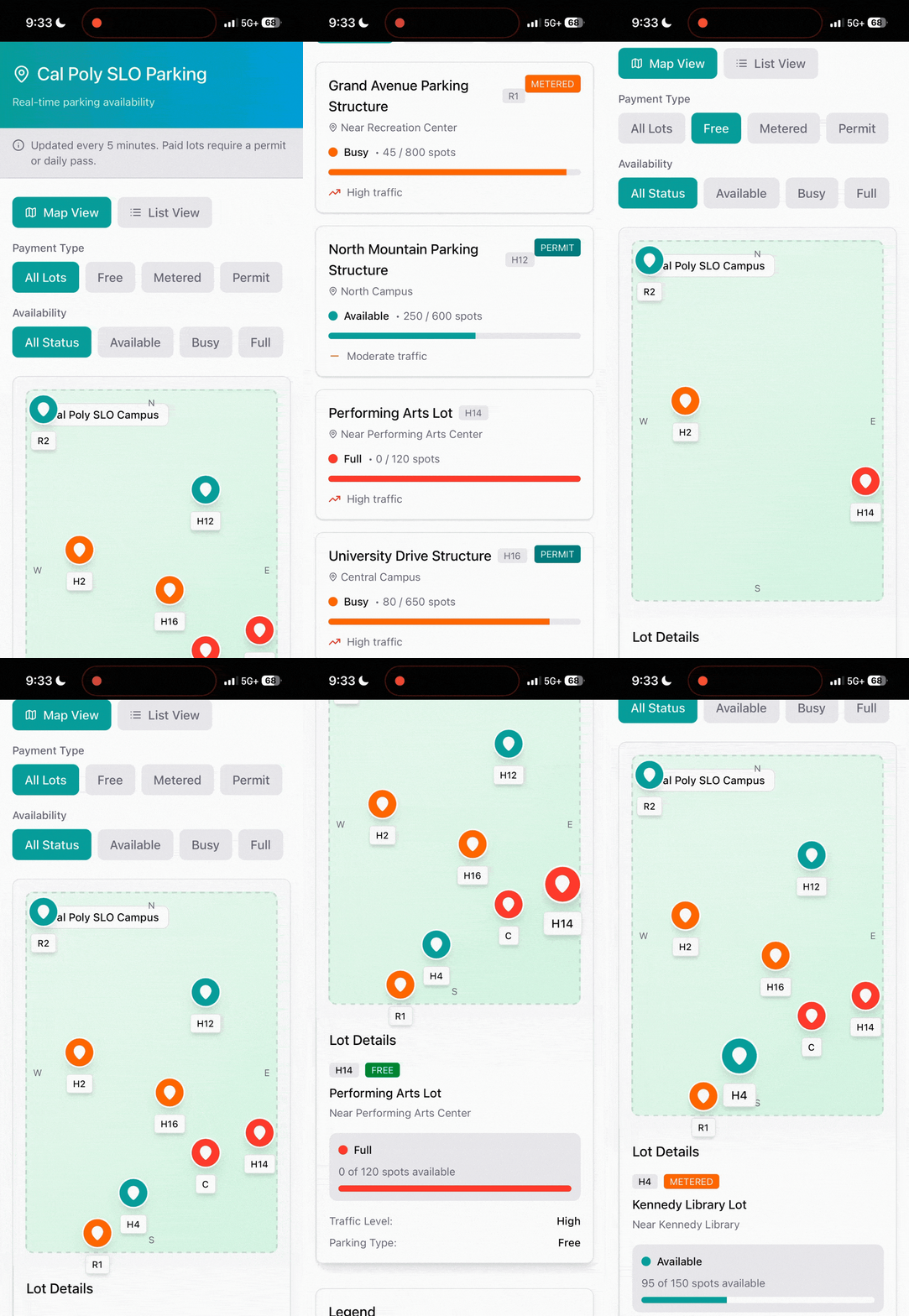
SpotHop is a mobile application concept designed to help college students quickly locate available parking using predictive and real-time availability data. Working in a multidisciplinary team, we followed Lean LaunchPad methodology to validate the problem through customer interviews, develop a business model, create a landing page MVP, and test market interest with real users.
Project Details
Duration
10 weeks
Role
Product Development Engineer
Team
Four multidisciplinary students
Project Type
Entrepreneurship & Product Development
Figma
Miro Board
Canva
Google Forms
Google Slides
Software
Skills
User Research
Product Design
UI/UX
Entrepreneurship
Customer Discovery
MVP Validation
My Contributions
Research
Customer interviews
Empathy mapping
Problem validation
Product Design
Feature brainstorming
UI mockups
MVP landing page
Entrepreneurship
Business Model Canvas
Value Proposition Canvas
Market validation
Flyer campaign
The Challenge
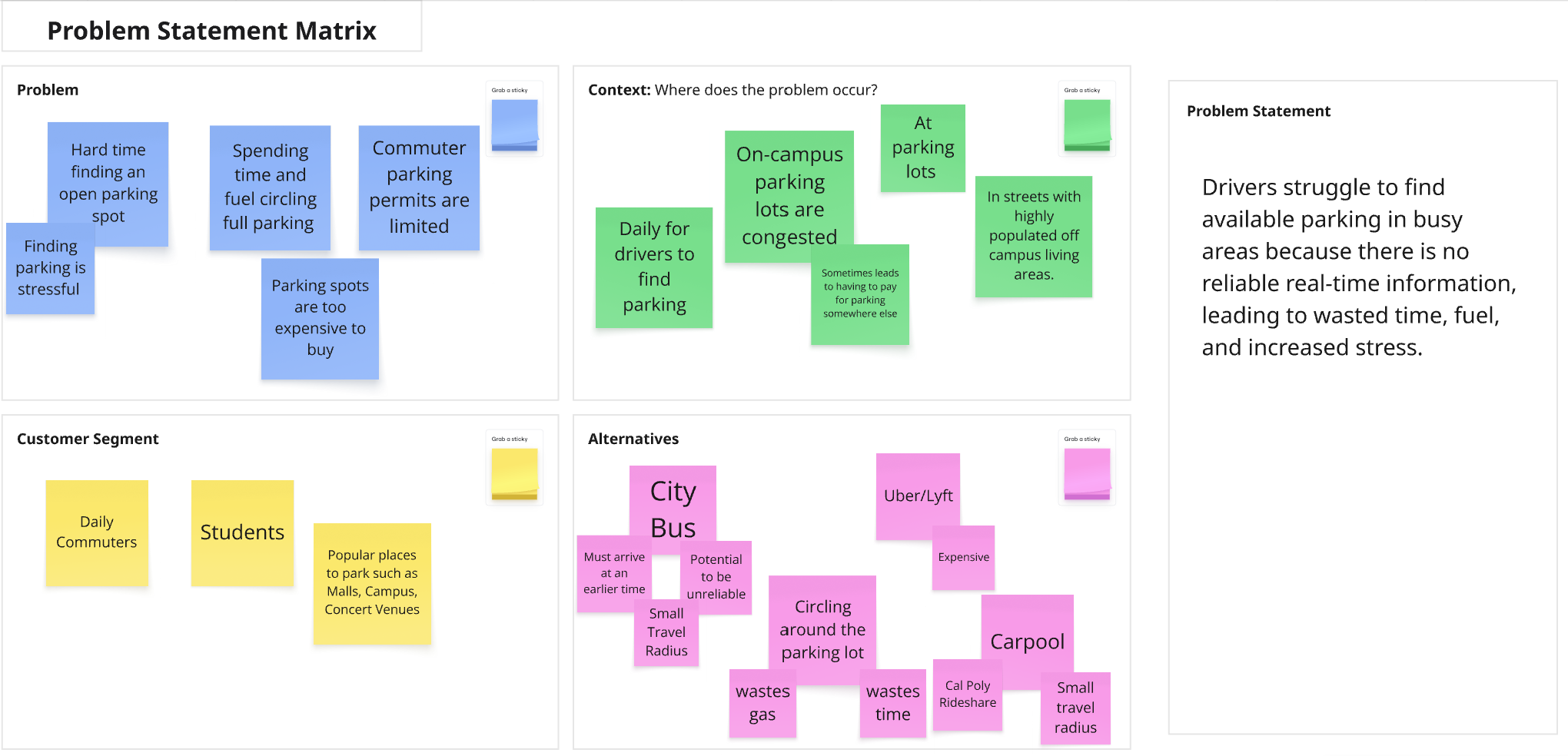
The challenge set out for our group was to come up with a real customer problem and design a validated solution. The customer problem that we looked at involved parking on campus, where students spend time and fuel looking for parking spots owing to lack of access to accurate and current information. The task was to assess the significance of the problem and the students' interest in it.
Design Process
SpotHop was developed through four stages: validating the parking problem, refining the value proposition, building an MVP landing page, and testing student interest.
-
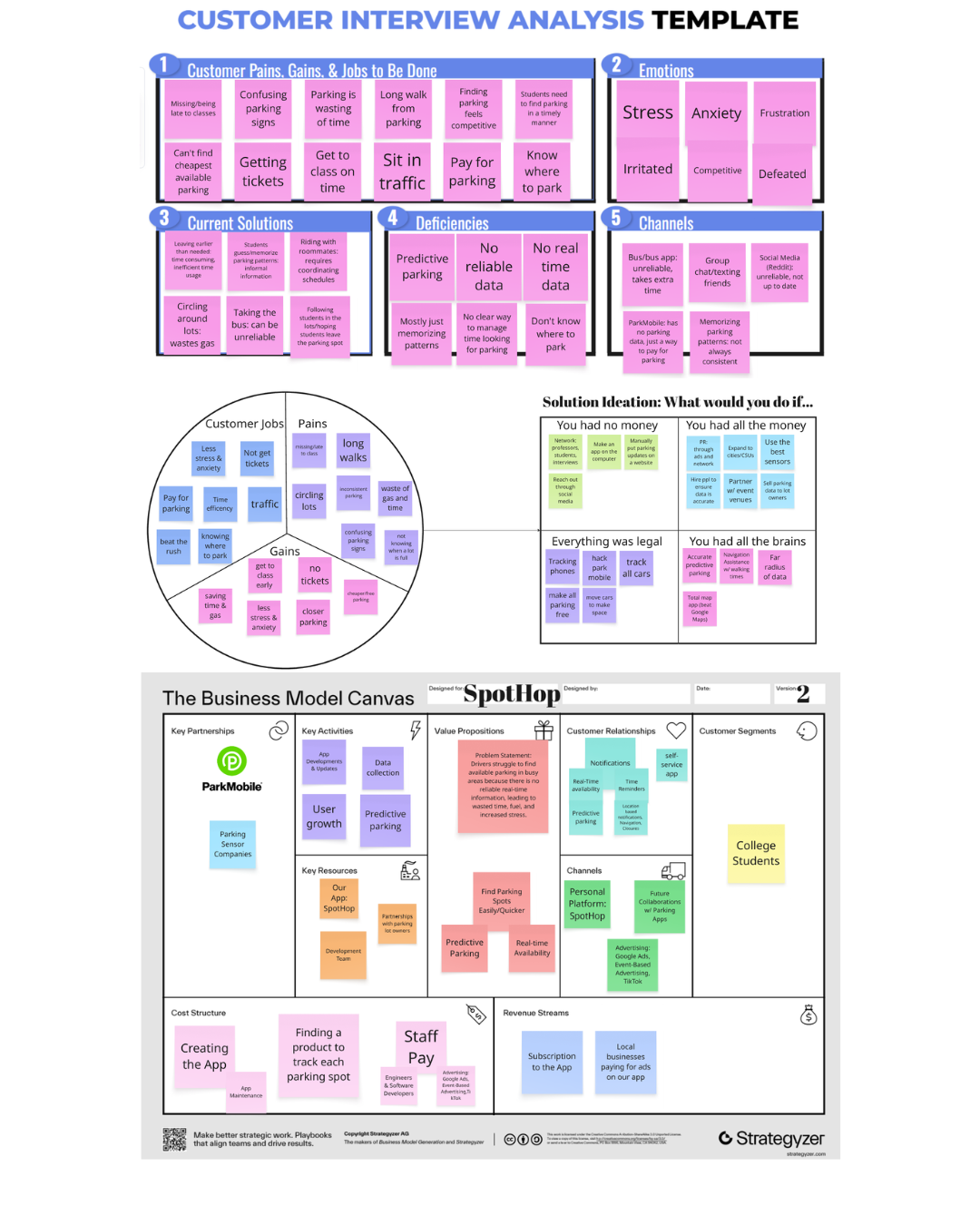
To start, we validated the need for solving the parking problem for our target audience prior to proposing any solutions. In conducting user interviews among Cal Poly students, we were able to understand their experiences with parking problems, what strategies they employed currently, and the effects of finding parking spots on their day-to-day activities. Our interviews were unanimous in demonstrating that many students spent time looking for places to park, showed up late to classes, and were stressed due to such problems.
-
Based on learnings from our customer discovery phase, our team was able to define the product more clearly using the Business Model Canvas and the Value Proposition Canvas. Our target market was narrowed down to students at the university level who will benefit from the prediction and live availability of parking spots offered by the application. This way, we were able to develop an application that addresses the problems of students.
-
Instead of creating an application, a minimum viable product (MVP) was created in order to determine whether or not the idea was worth spending time on developing software for. The MVP we created was a landing page, which included the proposition of what the app is all about and how users should sign up for an email list to use it.
-
In order to assess demand for a product other than through customer interviews, the MVP was marketed through campus-wide flyer marketing, social media marketing, and student surveys. These tests resulted in more than 500 page visits on the landing page, 53 email subscriptions, and 48 surveys being completed, thus showing quantitative proof that there is indeed demand for an alternative parking solution from students.
The Results
500+
Landing Page
Visits
53
Email
Signups
48
Survey
Responses
The MVP demonstrated measurable interest from students and validated that parking availability is a meaningful campus problem worth solving. Interview feedback consistently highlighted wasted time, stress, and lack of reliable parking information as the primary pain points.
Reflection
This project has reinforced the significance of verifying the problem before spending effort and money on finding a solution for it. By conducting customer interviews, testing assumptions using a minimum viable product, and analyzing customer engagement, we have discovered that customer feedback is vital when making decisions during product development. Moreover, the current project revealed the importance of developing an audience before releasing a product. Early audience development is important since it shows whether there is a need for such a product on the market and helps in future product development. Additionally, collaboration with the multidisciplinary team helped improve my skills in communicating between disciplines.